


The Good, The Bad and The Ugly: 2021
It’s that time of the year again, and we take a look back at the events that have impacted our industry in 2021.
Where do you start? 2021 has proven to be as equally as eventful as 2020. Before writing this article, I decided to read what I had written in the same article this time last year. Many of the things that I touched on last year are still ongoing issues.
COVID, housing crisis, social housing waitlist and a pretty dysfunctional heating calculator were all aspects of my article 12 months ago and will continue to be issues going into 2022. Also, how the industry tackles the unvaccinated will be a complex and intriguing challenge that we will all have to tackle over the next few months.
However, that is in the future. For now, we will turn our attention to the good, the bad and the ugly moments as we take a look back at 2021.
The Good: The Privacy Commission Guidelines
For too long, too many of us have been conditioned to treat tenants and prospective tenants as if everyone is a potential psychotic ‘Meth manufacturing’ gang affiliated and anti-social reprobate. Application forms were too long and arduous, asking for way too much information. Yes, landlords have a right to know who is going to be renting their property but likewise, we as an industry have a responsibility to protect tenants data and privacy and only collect information as to what is actually necessary.
Multiple credit checks on multiple agencies would negatively impact prospective tenants’ credit history and this would be unfair, particularly in a tight rental market. Any tenant who would refuse to give consent to information being collected would find themselves at a huge disadvantage in regards to being selected and because of this, many tenants feel that they have no option but to consent to so much information being collected.
The recently released new guidelines came about after John Edwards, the outgoing Privacy Commissioner, expressed concern after a ‘Bad Tenant’ database group had been established on Facebook. Mr Edwards is well known for his dislike of certain social media platforms and announced that the practices adopted by landlords and property managers were to be investigated.
Enter Jackie Adams, a tough ex-police officer from Northern Ireland who is now the manager of Compliance and Enforcement for the Privacy Commission. He headed the investigation and had the responsibility to come up with new guidelines for landlords and property managers with regards to how they can select tenants and how they must manage the information they can collect.
The outcome is a great result for everyone as it gives clarity in regards to what we can collect and what we must do with the information once we have collected it. It also gives the Privacy Commission tools for enforcement as well as much needed protection of tenants and prospective tenants privacy.
A great outcome.
The Bad: The Government
I try to remain as non-political as possible when I write my articles. I will try to be as balanced in my views as possible and will criticise policymakers from both sides of the political spectrum if I feel it is necessary. In this article last year, I praised the Government in regards to its response to COVID and the passing of legislation that protected tenants and landlords.
This year, their performance has been nothing short of shambolic.
The party that was going to solve the housing crisis when they came to power in 2017 have completely lost their way and appear to be making policy on ‘the hoof’ in a forlorn attempt to control rising house prices and rising rents. There is a strong argument that many of their policies have simply made matters worse.
The issues started early in 2021. As we reported in our first newsletter of the year, the Government looked like it was going to miss the deadline that they had set for much-needed standards around what contamination actually is in regards to methamphetamine. Tribunal says 15 micrograms are in line with the Gluckman report whilst insurance companies are mainly going off the NZ Standards of 1.5 micrograms. This was meant to have been sorted out at the end of January 2021 as Government legislation stated that levels of contamination had to be set by then. That deadline passed and as we come to the end of the year, we are still no wiser.
Then, in March the Government announced plans to control house prices. Then they dropped a bombshell that no one saw coming. The removal of interest deductibility shocked everyone. This policy makes no sense whatsoever and has only led to further shortages of rental properties with rental inflation increasing at a much higher rate than normal. The latest Massey University Rental Report, fronted by professor Graham Squires showed that rents had increased 9.4% nationally in the year to June. This inevitably leads to more and more people turning to the state for assistance with an ever-increasing social housing waitlist. There are now over 25,000 homes required.

We have seen little, if any action taken on regulating the property management industry even though this was an election promise, but then again, so was ‘no new taxes!’
In October, they resorted to announcing a joint policy with National which is basically an admission that they realise that they cannot fix the housing crisis alone. RMA reform is overdue but giving homeowners the ability to subdivide and build new properties without the consent of neighbours appears to be rushed and may have unintended negative consequences.
In November, they announced an inquiry into the high cost of building materials which is going to achieve absolutely nothing as there are many factors out of the Government’s control that is leading to such issues and this inquiry appears to be motivated purely to gain political points.
And finally, to finish off the year, the Government announces that the Heating Calculator that has been such an issue, particularly when it comes to new builds, is not fit for purpose and they are going to have adjustments.
2021 is a year to forget in regards to the Government’s track record on housing.
The Ugly: Unethical advice
In the middle of the year, I started to receive an unusual amount of phone calls from property management companies based in Christchurch. Apparently, a number of companies had been advised that you need to change the word ‘renewal’ to ‘extension’ when a fixed-term tenancy was coming to an end and you wanted to offer the tenants a new term.
I thought that this was unusual and straight away, I understood what was going on. This was an attempt to avoid compliance with Healthy Homes standards. The issue here is that under the standards all new and renewed tenancies must comply within 90 days of the commencement of the tenancy or the renewal post 1st of July 2021. There is no mention of compliance when it comes to offering an extension.
Therefore, some companies had resorted to offering an 11-month extension rather than a 12-month renewal. I for one, found this type of behaviour to be utterly unacceptable as well as unethical. It may also be viewed as an attempt to contract out of the Residential Tenancies Act which is a breach of section 137. The risks of deliberately breaching this are severe if you are a property management company. A company could face pecuniary penalties of up to $50,000.
I question what benefits a company faces by using such tactics? They are only delaying the inevitable and aren’t we best trying to get our stock up to an acceptable level?
I, for one, would never promote this as a strategy. An extension when used should be for a genuine reason. Advice such as this will only entrench the views of many that our industry is unprofessional and unethical that has no duty of care to its tenants.
Farewell from me!! I have enjoyed the ride
I have been writing articles now for several years and I have to say, I never struggle to find something to write about. It is a fascinating industry to work in and there is never a dull moment. After seven years of being in business, I am gradually stepping away from Real iQ.
Being the owner of a company does give you the freedom to express yourself which I have thoroughly enjoyed. I have always tried to keep balance in my articles and not to be controversial for the sake of it. People can see through that. I hope that you have enjoyed reading my articles as much as I have enjoyed writing them and I thank everyone who has taken the time to read them and an even bigger thank you to the people who provide me with feedback whether it be good or bad.
That is it from me, make sure that you all get to spend time with your families and whanau over the Christmas holidays. Take care, keep safe and thanks again for your support.
David Faulkner

The social dilemma
The Government finally released information on its policy around interest deductibility with an exemption to social housing tenanted properties. We look at the potential issues with such a decision.
If you are a property investor, you are now likely to be impacted by the Government’s new policy that limits the ability to deduct interest against rental income. The highly controversial policy was announced back in March this year, yet, we have had to wait until now to see what this may look like.
The Government has a major issue as the Social Housing Register has increased rapidly over the last five years. In June 2016, there were only 3,876 applicants on the social housing register and when Labour came to power after the September 2017 election, the register had 5,844 applicants on the list. In just five years, this has ballooned to 24,474. Since Ardern has been Prime Minister, the register has increased by 18,630 or a staggering 318.8%. This is the Government whose key election promises back in 2017 was to eradicate child poverty and fix the housing crisis. So far, things are not going according to plan. In September 2017, the median weekly rent in New Zealand was $400 whilst the median house price was only $525,000. Since then, the national median rent in New Zealand has increased to $478.00, an increase of 19.5%, however house prices, as we all know, have skyrocketed. In June 2021, the median house price in New Zealand had increased to $820,000. That’s jumped by $295,000 since Ardern has been Prime Minister. This is an increase of 56.2%. House price inflation has been out of control.
The Social Housing Register: June 2016 to June 2021


As rents and house prices have increased, the waitlist has also ballooned in size. People and families on lower incomes have been priced out of the private rental market and have been forced onto the social housing register. Many more renters need accommodation supplements to help bridge the gap. The need for social housing is apparent and obvious.
Looking back at the Government’s announcement on tax changes for property investors, they announced what properties would be exempt from the controversial interest deductibility rule. Amongst the announcement around what properties were to be exempt, we were surprised to find out that property used for emergency, transition, social or council housing will be exempt from the interest deductibility rule meaning that you will still be able to offset interest against income. This is significant because landlords may be paying as much as an extra $50 to $100 per week in tax as the phasing out of interest deductions takes effect. As of April 2025, you will not be able to claim any interest on a standard residential rental property that isn’t a new build.
Then you can do the calculation around savings if you go out and buy an investment property and use it for social housing. Let’s look at the following example.
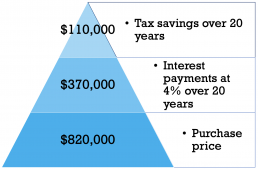
I decide to buy an investment property at the June median house price of $820,000. I take a loan at 4% over 20 years. I will be paying over $370,000 in interest. Doing a rough calculation of 30% tax, I will be saving myself $110,000 by being able to offset interest against income over the duration of the loan. When you look at numbers, it’s a very tempting proposition.
What this means is that investors may decide to lease their investment property to the likes of Kainga Ora or agencies such as Link People who will then use the property for transitional or social housing. There are obvious risks associated with transitional housing. However, those risks can be offset with agencies agreeing to reinstate the property to its original condition (minus fair wear and tear) and guaranteeing market rent. The state is not going to default on rent payments. When you work out the maths, if a landlord is going to save themselves anywhere in the region of $5,000 in tax per year, the risks look more and more appealing.
What has happened to house prices since Labour have been in charge?
|
|
September 2017 | September 2021 | Difference |
% Change |
|
Median House Price New Zealand |
$525,000 | $795,000 | $270,000 |
51.4% |
Median house price in New Zealand whilst Labour have been in Government. Sourced REINZ.
The question we are asking ourselves is whether we will savvy investors turn to older stock that will no longer appeal to more streamlined investors. You may find yourselves competing with fewer buyers and if successful, you can simply then rent out the property to a social housing provider. The state pays your rent whilst you offset the interest reducing your tax bill.
It could lead to issues in neighbouring properties if the occupant of a social house is not someone who is focused on positive relationships within the community. We do not want to stereotype the occupants of transitional housing, but the reality is that you will have a higher percentage of risk regarding having an antisocial and problematic occupant who causes issues within the community.
It can become a dilemma for a property management company if an owner instructs the property manager to lease the property to a provider of social housing. You have no say as to who goes into the property, and this will in some cases lead to issues in the communities that we look to build. Does a property manager refuse and risk losing the business, or do they accept and try to work proactively with the provider to ensure that the community is not being exposed to unnecessary risk as well as antisocial behaviour? Then you may find issues in unit title developments and in strata management blocks. Put the wrong occupant in an apartment block and could have dire consequences for the occupants and owners of neighbouring apartments.
The other issue that may arise due to the nature of this policy is that we may see a further reduction of stock from the private rental pool. If landlords decide en masse to move away from the private to the social sector, you could see further issues around the shortage of rental stock. This could lead to rents increasing at even higher rates which will then lead to more people turning to the state to seek assistance. We are in a vicious circle that may not be broken until sufficient housing stock becomes available.
Then you get a situation where young families renting give up in trying to get ahead. Why should I battle in the private rental market when I can apply for a brand-new state house? I end up on an income-related rent subsidy and my rent is capped at 25% of my income. This is not the attitude we want to encourage whilst our economy is freefall due to lockdown and annual inflation surged to 4.9%, the biggest annual movement in more than a decade.
To further exasperate the issues, one local council is in dire straits as it haemorrhages money as it tries to provide affordable rentals from its own housing stock. Wellington City Council’s social housing arm City Housing is scheduled to become insolvent by June 2023. The council does not qualify for Income Related Rent Subsidy (IRRS) and therefore ratepayers are subsidising rents. This may lead to the council outsourcing its housing portfolio to community housing providers in order to be able to claim the IRRS.
Potential tax saving over 20 years by renting to a social housing provider
Everywhere you look, there are major issues in the social housing space. The only real solution to the problem is to increase supply drastically. A surprise announcement that there will be a collaboration between Labour and National in developing a housing policy that aims to increase housing supply by over 100,000 new homes in less than a decade is a good place to start. A greater intensification of our cities and reforming of the Resource Management Act is a step in the right direction.
The social housing tax policy could be another Government decision that has unforeseen consequences that can negatively affect our communities. On the flip side, everyone in New Zealanders deserves the right to have a roof over their heads in a warm, safe, and dry home.

Should the Healthy Homes Deadline be extended?
Lockdowns have meant that many landlords will simply fail to comply with the new standards. We argue that they should be given more time.
On the 10th of September, Transport Minister Michael Wood made an announcement. The Transport Minister stated that due to the outbreak of the Delta variant and the lockdowns which have affected so many people, driver licences, Warrants of Fitness, Certificates of Fitness, vehicle licences and licence endorsements that expired on or after 21 July 2021 will be valid until 30 November 2021.
In a press release, Minister Wood stated that “Lockdown is stressful. People shouldn’t have to worry about getting fined for having a recently expired WoF if driving to access essential services or as an essential worker.”
This was a sensible approach after pressure had been put on the Government by the Road Transport Forum (RFT). Chief executive of the RFT Nick Leggett stated that “In our heavily regulated industry, paperwork matters”.
This leaves us asking a simple question. If transport gets to park their WoF’s until the end of November, what about landlords?
With the introduction of the Rental Warrant of Fitness (RWoF), landlords are facing deadlines of their own and for many, these will now be unattainable due to the lockdown. If you are a landlord in Auckland and you rented your property post 1st of July 2021, or you renewed a lease, you have a 90-day deadline to ensure that the property becomes compliant with Healthy Homes standards.
All is well and good, but when a region is locked down and your rental property is non-compliant with healthy homes, your 90-day deadline does not stop. The outcome of this means that many landlords will end up breaching healthy homes standards and there is absolutely nothing that can be done about it.
When it comes to assistance from the government in these days of lockdowns and pandemics, landlords never seem to get a look in. If the Government is prepared to offer extensions for vehicles that are on our roads, wouldn’t it make sense to offer extensions to properties as well, especially as the days get warmer and longer?
I am fully supportive of the healthy homes initiative and we need legislation that forces landlords to raise the quality of their rental properties. The poor quality of much of the rental stock in New Zealand has been highlighted by many in recent times. As more and more people rent for longer periods of time, healthy housing is essential for the well-being of our country.
However, as the first deadline came and passed, it became apparent that much of the housing stock that has been inspected for healthy homes compliance has fallen short of the standards required. This was highlighted by a nationwide company that carries out healthy homes inspections. Of the 14,000 inspections that it had carried out, approximately, only a quarter of these inspections passed current healthy homes standards. This will not come as a surprise for many.
What has been an issue is that the Government also admitted that they were having significant issues with their heating calculator. Many new builds were failing healthy homes inspections due to the open plan nature of many of the properties. The concern that the Government has is that the heating calculator is inaccurately overstating the heating requirements for the living space, meaning that many landlords are being forced unnecessarily to spend money on extra heating that is not likely to be required.
The role out of healthy homes has therefore been seriously compromised by a heating calculator that is apparently not fit for purpose and a lockdown that is leading to delay times in getting properties compliant that will likely surpass the 90-day deadline. Surely it makes sense to extend the deadline.
ACT Deputy leader and housing spokesperson Brooke van Velden has picked up on the issue in regards to Healthy Homes compliance. She recently stated that common sense and compassion must be used with regard to rental regulations. A level 4 lockdown means that tradespeople have been unable to carry out work that was required for the Healthy Homes Standards and there will now be massive backlogs. This may not be a major issue outside of Auckland where the rest of the country had to endure a three-week lockdown, however, Auckland, which has had to endure a far longer lockdown, will have major issues and many properties will now be in breach of the Residential Tenancies Act.
Van Velden went on to say that ‘The Government said that all private rentals must comply within 90 days of any new or renewed tenancy after 1 July 2021. This simply won’t be possible for some landlords now and it’s through no fault of their own.’
Some will argue that landlords have had plenty of time to get their properties compliant and there should be no change to the deadlines. There is no doubt that landlords have had time, but dates are set so landlords can manage their time and resources. If unforeseen circumstances lead to many landlords not being able to meet deadlines, it is unfair to penalise them as there has been no intent to not comply. And remember our Government has set their deadline until July 2023 to comply with Healthy Homes. Some would argue that they are being somewhat hypocritical. Do as we say, not as we do.
Likewise, when you have a Government that is fully aware of issues with regards to the Heating Calculator, you may argue that from a legal point of view that it would be impossible to write an order against a landlord when you cannot accurately assess whether the property is compliant or not.
Then, to add to this, there are delays in obtaining stock such as heat pumps. As goods cannot be moved out of Auckland as well as a general shortage of supplies, this further compounds the issue with regards to achieving compliance deadlines.
In this case, Brooke van Velden has a strong case. It makes sense to extend the 90-day deadline until April 2022. This should not be a major issue for tenants and should not impact their comfort. If there are issues around drainage or dampness, then a landlord still has a legal obligation to rectify this regardless of whether Healthy Homes standards are in place or not. This has been law since the inception of the Housing Improvement Regulations 1947. If a rental property has issues with drainage or dampness then it is potentially breaching multiple pieces of legislation and in particular, Landlords Responsibilities under the Residential Tenancies Act. The maximum amount of exemplary damages for breaching this, $7,200. Tenants are already well protected.
As warmer months arrive, the issues we see around cold and dampness will be less of a concern. The extension will give enough breathing space for landlords to get their properties compliant without putting unnecessary and unrealistic demands on them.
We all want and require a warm and dry housing stock, we just want a bit of commonsense to prevail.
If vehicles and motorists can be given a grace period, then surely rental properties and the landlords who own them should be treated the same. This isn’t a case of negating your responsibility as a landlord. It is about making a minor change to cater for unforeseen circumstances so landlords are not in breach of their obligations even though they’ve done nothing wrong.
David Faulkner

Calls for Rental WOF reignite as Healthy Homes kicks in
Green MP Chlöe Swarbrick has called for the introduction of the Rental Warrant of Fitness (RWOF) to ensure Healthy Homes standards are being met
Swarbrick made the call in what was an engrossing interview on the AM Show with host Ryan Bridge. In the interview, Swarbrick went head to head with Mark Richardson, the opinionated and right-leaning sports reporter, over the introduction and implementation of the RWOF. The exchange resulted in Richardson branding Swarbrick as ‘naive’ whilst Swarbrick called out Richardson for ‘victimising himself’ in a fixating interaction.
It was as if you were watching a frustrated Father trying to educate his rebellious but academic daughter as to why so many people invest in property. It was a tense, engaging and utterly compelling viewing. It also highlighted the increasing inter-generational gap that has developed in recent times. The wealth gap between the haves and the have nots has led to a younger generation rightfully feeling aggrieved that the prospect of homeownership has become more and more out of reach.
In truth, both Richardson and Swarbrick were right in their assessment of each other. In particular, Swarbrick was exposed when she did not understand that most Mum and Dad landlords had to ‘top up’ the rent with their own income, believing that the rent would more than cover the mortgage. However, when it comes to the RWOF, I think she is right on the money.
Yes, everyone is fatigued with adapting to so much change and in such a short timeframe but the management of healthy homes does not and should not end when the final deadline is reached on the 1st of July 2024. Houses depreciate as do the fixtures, fittings and other features that help keep a property warm and dry. At some point in the future, someone will have to go back to the property and check for compliance. The RWOF gives you the ability to do this.

Swarbrick is not the first person to make this call. We beat her to it over two years ago.
Back in March 2019, we predicted that the RWOF would eventually find a home with the Healthy Homes Standards after its attempted implementation by the Wellington City Council ended in disarray and ridicule. Hardly any landlords took up the initiative introduced by the Wellington City Council and those landlords that did were highly critical around the quality of assessment and reporting.
The RWOF was first introduced by Professor Phillipa Howden-Chapman and her team at Otago University, basing compliance on a set of 29 different criteria. If you failed one of the criteria, you failed the RWOF. The concept of an RWOF is not a silly idea and in principle, I fully endorse it. However, the original concept was too onerous and in my opinion, felt like a ‘Nanny state’ setting criteria for things such as the size of your sink in the kitchen and assessing the temperature of hot water. What we recommended back in 2019 was that the RWOF should be adopted to work in conjunction with the Healthy Homes standards with assessments being undertaken every three years. Now Swarbrick has renewed the call and has taken the mantle of being the undisputed champion and spokesperson for the tenants. This fits her profile perfectly. Being a tenant herself and at the young age of only 27, the Central Auckland MP can easily relate to her target market and most of her constituents will likely be of a similar demographic.
Healthy homes implementation is not without its issues
I have recently finished a stint working as the acting General Manager for Tommy’s Property Management in Wellington and as such have been well placed to see the issues in dealing with the project around Healthy Homes implementation.
It has not been without its challenges.
Dealing with landlords can be complex at the best of times however trying to explain to landlords that new builds that they have purchased are non-compliant due to insufficient heating has probably been one of the more challenging aspects of the job. They certainly do not hold back when sharing ‘their opinion’ of our assessments or of the Government! Having these conversations can be incredibly draining for the poor Property Managers working at the coalface. They are simply the messenger doing their job and repeating the same conversation day after day can take its toll. We have also seen Healthy Homes assessors failing houses with central heating as they have no way of calculating the heating output, even though you can tell the home is warm and dry. The law of commonsense has long since been repealed!
I do sympathize with landlords in these situations. You are being asked to spend thousands of dollars on heat pumps that will likely never be used as the house is already sufficiently warm enough and tenants do not want to waste money on a heating source they do not need. It has left me scratching my head as to how a new build, which has building consent from your local authority, is all of a sudden non-compliant and cannot be rented out. In a stunning admission by Associate Minister for Housing, Poto Williams, she admitted that the Government were having “significant” problems with the Heating Calculator in regards to new builds and apartments due to the open plan nature of the living space. It comes as no surprise as everything this Government tries to implement with housing seldom ever goes to plan.
The reality is the Healthy Homes implementation has and will continue to be a significant challenge to the Property Management industry. Booking in assessors, dealing with landlords who refuse to comply and project management of contractors is a daily occurrence. And now you also have tenants who are feeling more and more empowered as they have no fear in exercising their rights. They know that they will have name suppression in the Tenancy Tribunal and that they also cannot be given notice by their landlord without a valid reason. Tenants are starting to realise they have significant control and power.
Change is hard, but change is necessary
Regardless of your political beliefs, it is difficult to argue with Swarbrick with regard to certain aspects of her argument. The cost of an assessment every three years is hardly going to break the bank and she is right when saying that ‘people who rent their home shouldn’t have to get sick or complain before the safety of their home is tested and guaranteed’. An RWOF should technically remove that from being an issue and it should lead to a reduction in Tenancy Tribunal claims by tenants which are on the increase. There is also the environmental argument around the implementation of an RWOF. New Zealand has committed to being net carbon neutral by 2050 and for this to happen, every industry will have to play its part including the residential rental sector.
As ever with the implementation of such a policy, the devil will be in the detail and it will not be straightforward. In the exchange between Richardson and Swarbrick, Richardson rightly pointed out that the cost after an assessment will increase as it is like taking your car in for a WOF, there is almost always added expenses. Swarbrick’s response was that the assessor should be independent however policing that will probably cost more than what it is worth and the taxpayer will again have to pay.
Energy Performance Certification should be introduced as well
If an RWOF is introduced, it should also include a mandatory Energy Performance Certification or an EPC, grading the property energy use as well as giving recommendations as to how to improve energy efficiency. These are mandatory throughout the EU and the UK. An EPC gives a property an energy efficiency rating from A (most efficient) to G (least efficient) and is valid for 10 years. For a property to be rented to tenants, the property must achieve a certain standard. The benefits of the scheme are obvious with a more energy-efficient property leading to lower emissions as well as transparency for tenants who can easily budget what the power costs will be. There will also be health benefits as well for the occupants of the property.
No one in this country should have to live in a property that is bad for their health and the environment. I believe we will see an RWOF introduced within the next five years and no one should be opposed to this. Renting out cold and damp properties is no longer acceptable or ethical. I’m behind Chlöe on this one. It’s a good idea that should be adopted.

Reinventing Renting: The need for long term tenancies
Why New Zealand needs a mind shift away from homeownership as Government releases its discussion document with regards to tax reforms around residential rentals
In March 2021, the Government announced a wide range of reforms with the goal of making residential properties more affordable for potential owner-occupiers. The reforms are highly controversial and, with regards to the removal of interest deductibility, hugely unpopular. The Government has released its discussion document with regards to the design of the interest limitation rule and additional bright-line rules and is inviting submissions on the proposals.
With that in mind, we have decided to put our own thoughts in writing and what we write here will be the basis of our submission. Although tax is probably not the most exciting of topics to write about, the significance of these proposals could have a detrimental effect not only on both landlords and tenants but also on the property management industry.
Landlords will be forced to aggressively increase rents whilst also potentially looking to either vacate the market or cut costs wherever they can, leading to fewer rental properties which will deteriorate due to a lack of maintenance as well as capital expenditure.
Flaws with the Government’s goal
The Government states within the discussion document that it wants to improve affordability for first home buyers by dampening investor demand[1]. However, this flies in the face of the Government’s actions who have reportedly purchased over 1000 homes from the private sector for public sector housing. This is housing that could have been purchased by first home buyers.
And since the radical announcement with regards to housing, what only appears to have happened is that the housing market has gone into its own lockdown with stock drying up leading to a huge shortage of property available for sale. The REINZ monthly report for May 2021 shows that housing inventory is at its lowest level ever with May listings dropping below 15,000 across New Zealand. This is only the second time this has happened since records began. Meanwhile, housing prices continue to hold. The median sales price for May 2021 is $820,000. This is a $200,000 increase from May 2020. So far, Government intervention has not had the desired effect.

The other aim that the Government has set out is to ensure that every New Zealand citizen has a safe, warm, dry, and affordable home to call their own, whether they are renters or owners.
From a tenant’s perspective, the interest deductibility rule is likely to have negative consequences. Tenants will be subjected to a more aggressive rental increase in an attempt by landlords to recover the losses they will be subjected to whilst landlords will look at cutting costs through maintenance and self-management. I do not see how this achieves the Government’s objective. So, if Government intervention fails what can be done?
The obvious thing to do is to increase supply, particularly of three-bedroom homes as this is what is always in the highest demand. However, this will take time and it will not be cheap. A lack of skilled labour, building materials and infrastructure means that it will be years before demand catches up with supply. The building industry already looks to be at maximum capacity.
The chances of the Government backtracking on its housing strategy are probably as likely as a cycle bridge being built across the Waitemata Harbour on time and under budget. It isn’t going to happen! My own opinion is that we need to work with what has been put on the table even if it does leave a sour taste in your mouth. I have no problem with the extension of the bright-line rules being extended from 5 to 10 years, in fact, I even like it. It means that more rental properties will be leased long term. Remember, the country needs rental properties and private landlords will house roughly 30% of the population.
It is the interest deductibility that most people, including myself, have serious misgivings about. It is hugely unfair and increases expenses on the landlord by as much as $100 per week which will lead to higher rents. As we have previously mentioned, there are no winners.
Why is homeownership such an important desire?
The reality is that many people who rent will not be able to buy a property, even with the Government measures being put in place. Infometrics economist Brad Olsen points out the house prices must drop by a whopping 55% or wages have to increase by 123% if we really want affordable housing[2]. That isn’t going to happen.
So why not reinvent renting?
Why do we have to aim for homeownership? Looking at my own circumstances, when we moved to Wellington 6 years ago from Palmerston North, I was nervous as hell doubling the size of my mortgage whilst starting a business with no guarantee of income. I sit here now wondering why I was so worried at the time. I do, however, worry about our future generations. Our kids will be paying around the region of $1 million for their first home which to me, is frightening. A mortgage of such size is a staggering amount of money. When interest rates do rise, servicing these mortgages will become increasingly challenging and that is bad news for everyone.
So why not make renting so desirable that people will look at alternative ways to build equity and wealth other than bricks and mortar?
Think differently. Long term tenancies the answers.
Let’s look at Germany as an example. In Germany, the average length of a tenancy is 11 years and nearly 50% of the population are tenants. In New Zealand, the average length of a tenancy is extending but it is still roughly less than 2 and half years with one-third of the population renting. If the Government’s aim is to have stability and security for tenants, then we have to think differently.

Our idea is to incentivize landlords to offer long term contracts to tenants whilst giving tenants the flexibility to give notice when their circumstances change, and they decide it is time to leave. If a landlord provides a tenant with, for example, a fixed-term tenancy for 10 years then they can be exempt from the interest deductibility rule.
Tenants will have a place that they can call home and establish roots in communities whilst their children will remain in the same schools with the same friends. This benefits New Zealand as a whole. The agreements will be written in a way that allows a tenant to give notice meaning that they do not have to pay break lease fees when they decide to leave.
Tenants are now already able to make minor changes to the property and with healthy homes standards being implemented, technically, there should be no issues with regards to tenants living in unhealthy conditions. These agreements will allow tenants to have pets and landlords will not be penalized with regards to interest deductibility meaning that there will be less pressure with regards to increasing rents and no need for cutting costs on maintenance.
Bonds can be replaced with tenants paying specialised tenant insurance which can protect them from accidental damage or temporarily support them if they find themselves in financial hardship due to losing their job or income. There will be no need to undertake intrusive three-monthly inspections which, in my opinion, are invasive and unnecessary, particularly if you have long term tenants who have a great record.
The purpose of this is to ensure that landlords are motivated to provide long term rental accommodation that fits the needs of both tenants and investors.
There are other things that the Government needs to consider with regards to the implication of the tax policy on housing
Exclude purpose-built rental accommodation from interest limitation rule
The current laws around interest deductibility are simply unfair as it particularly penalizes landlords who own multi-unit dwellings or student accommodation. These types of properties are not going to sell to first home buyers and essentially if you own these you are stuck with them as whoever purchases them will have to allocate roughly 30% of the rental income to tax from day one. Investors who own such properties should be exempt from the interest rule.
Allow interest deductibility on renovations
The Government’s policy hurts tenants in other ways. Landlords will simply have no incentive to do extensive renovations on their properties since any extension on their mortgages that they establish will automatically not be allowed to be offset against rental income. Therefore, more and more rental property will simply be let go and will not be maintained. This makes no sense at all when there is a huge push to get landlords to improve the quality of their stock.
Will the Government listen
When Grant Robinson announced the changes, he specifically used the terminology that landlords were speculators. Well, if you are offering a tenancy for 10 years, you can hardly be called a speculator. This will mean that rental properties are long term investments that will meet the needs of the tenants and landlords alike. Landlords will be incentivised to improve their properties increasing the quality of the product for the tenant. A win-win for all.
Most landlords are in it for the long haul, and they are a vital component of the housing structure of New Zealand. Rather than vilifying them as the problem, let’s look at how we can collectively get round a table and work together to find a solution.
[1] Design of the interest limitation rule and additional bright-line rules; A Government discussion document. Hon David Parker, Minister of Revenue
[2] Newshub report by Jenna Lynch 25th March 2021

Who let the dogs out?
The time has finally come to let tenants have pets. We explain how it can work to keep both parties happy. Are we breaching Human Rights by not allowing tenants to have pets?
There is a new victim in the apparent rental crisis across New Zealand. Pango, the pet dog of a Porirua tenant is in trouble. The tenant’s landlord is selling the rental property so this tenant has to find a new property to rent that will allow pets. Unfortunately for Pango, this is not proving easy and Pango is not alone.
In a recent article that made the news, it was reported that a number of tenants are being forced to give up their beloved pets in an attempt to secure a rental property. The apparent shortage of rental stock is proving to be a major obstacle for tenants who have pets and in particular, dogs. This has been an ongoing problem for many years but as rental stock becomes more scarce, the problem is being exemplified. Many landlords may feel that they are spoilt for choice when they rent out a property. If there are multiple tenants who are applying for a property, it is solely dependent on the goodwill of the landlord as to whether they will accept a tenant who has a dog. This is pretty unfair. If I own my own home, then who is to stop me from having a pooch as part of the family but if you rent your home you may not be so lucky.
Is it time to change our rules so that tenants can own pets without the necessary consent of the landlord?
'I cried the whole way home': Sharp increase in renting Kiwis forced to give up their dogs – stuff.co.nz 23rd May 2021

Time to let the dogs in!
In our opinion, the law should change. In fact, back in 2015 in one of the first articles that I ever wrote, I argued back then that it was unfair how perfectly acceptable tenants were being overlooked for rental properties due to the fact that they owned a dog. Six years later, my views have not changed.
Many years ago when I was a Property Manager, I encountered many excellent tenants who were struggling to find accommodation due to the fact that hardly any landlords accepted pets. What I used to do was to show them the property, even though the landlord specifically stated that they wanted no pets. If they liked the property, I could usually convince the landlord to put the tenant on a three month trial period (couldn’t do that now!!) and got the tenants to provide council records of the dog as well as sign a separate pet agreement that confirmed that they would treat the carpets for fleas as well as have the carpets commercially cleaned (again, unacceptable now with our nanny, pedantic state!!).
What you may likely find is that tenants who commit to these clauses typically turned out to be outstanding tenants who were truly house proud and just grateful that we would give them a go. I cannot think of a time when taking such an approach ever backfired.
So why, six years on, are we still debating whether tenants should be allowed pets and why was it left out of the recent Residential Tenancies Amendment Act 2020?
Why were pets left out of the recent reforms?
When the discussion documents for the proposed changes were announced back in 2018, many, including myself believed that tenants being allowed to have pets would have certainly been passed and become law. However, when the first reading of the Act was introduced, it surprised many to see that the introduction of pets in rentals was omitted.
A document released by the Ministry of Housing and Urban Development covering questions around the reforms which was released in September 2020, went into why the issue around pets was left out of the Amendment Act.
The reform document stated that the issue around pets was the most debated of the proposed changes with strongly opposing views held. In the opinion of the Government, their reasoning was because it caused so much debate and there was such an even split, it needed more time to come up with a solution.
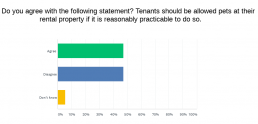
In submissions made by stakeholders around the issue around pets, 83% of landlords considered that landlords should be able to decline pet requests without giving a reason. Unsurprisingly, tenants believe that pet ownership should not be a privilege reserved only for homeowners. The Government has yet to make a decision.
As rental properties and in particular, three-bedroom homes which are always in short supply and are typically suitable for dogs become increasingly hard to find, many tenants are being forced to give up their pets.
In our opinion, tenants should be allowed pets but there should be rules in place to protect the landlord’s investment as well as protect the wider community.
To me, it makes sense to allow a tenant the right to have a dog, but the landlord should be able to place certain terms into the Tenancy Agreement that gives added protection. For example, having in the agreement that the tenant agrees to allow the landlord to organise professional carpet cleaning and flea control at the end of the tenancy. Maybe landlords can stipulate what breeds of dog are suitable? The landlord should be able to state how many pets the tenants can have. The landlord should also be able to state in the Tenancy Agreement that the tenants agree to abide by the Dog Control Act 1996 which sets out statutory regulations in relation to the ownership and control of dogs. The outcome of failing to abide by these rules would mean that the dog would have to be removed from the property or if the tenant fails to give up the dog, then the tenancy can be terminated. This could also fall into the antisocial tenant category that came into effect in February 2021.
If the tenant is renting in a Body Corporate, then Body Corporate rules will override the Residential Tenancies Act if the rules state that occupants cannot have pets.
Pets play such an important part in the emotional well-being of individuals as well as families who own them. Every dog owner I have spoken with has stated that the dog is part of the family. This leads us to the next point.
Is refusing to allow pets a breach of Human Rights?
If a dog is truly a member of the family, are we breaching the Human Rights Act by not allowing a tenant to rent property due to the fact that they have a dog? Section 12 of the Residential Tenancies Act states that discrimination is an unlawful act. Maximum exemplary damages can be as high as $6,500.
Then take a look at section 21 of the Human Rights Act. This outlines what the 13 grounds of discrimination are. Here it states that you cannot discriminate on family status. You could argue, even though a dog is not human, the family clearly are and therefore a family has been discriminated against due to the fact that they own a dog.
In my opinion, the issue has never been the damage that has been done by the pets, more so issues around neglect by the tenants. In the renowned Tenancy Tribunal case of Guo v Kork, the Tenancy Tribunal rightful rules in favour of the landlord after a sick dog continued to urinate and vomit on the relatively new carpets, meaning that at the end of the tenancy, the landlord was forced to replace the carpets. The tenants argued that this was accidental damage and therefore, they should not be liable.
In the end, common sense prevailed and the adjudicator ruled in favour of the landlord awarding $10,000 for the replacement of the carpets.
Landlords can insure themselves against damages caused by pets whilst tenants can be held liable for the full damage caused by their pets if they fail to control them. Therefore, we believe that the time has come to show some heart and change the Residential Tenancies Act to allow tenants to have pets in their homes.
So, to all of you landlords out there who own a dog. Ask yourself, would you give up your dog for your home and not be resentful?
It is now time to let the dogs into rental properties.
Our recommendation for pets
Introduce new sections to the Residential Tenancies Act (RTA) that allows tenants to request a pet and landlords cannot decline that request unreasonably.
Also, introduce a new section to the RTA specifying that tenants are responsible for the actions of their pets and continuous damage caused by a pet is deemed to be intentional damage meaning that the landlord is not limited in the damages that they can seek.
Allow landlords to have a separate pet agreement and write in special clauses making it compulsory that tenants get carpets commercially cleaned and flea treated at the end of a tenancy.
All tenants with dogs as pets must comply with the Dog Control Act 1996. If there is an issue that leads to a Tribunal hearing, the tenant must prove under the balance of probabilities that the dogs are not in breach of this legislation.

There will be no winners: Industry survey results on Government Housing Policy
Industry survey slams ‘out of touch’ Government with regards to their handling of the housing crisis. Nearly three-quarters of those surveyed express concern about their situation following the Government announcement.
The comments from one person surveyed summed up the feeling of the Property Management industry following the Government’s radical housing policy announcement on the 23rd of March. ‘Short-sighted. There will be no winners, more owners will sell and there will be fewer houses to rent.’
There is no doubt that the Government’s attack on landlords is bad news for our industry. Small businesses in particular could really struggle as the pool of investors begins to dry up. We have already seen emails from landlords to Property Management companies saying that they would rather leave their properties empty.
This prompted us to carry out a survey on the Property Management industry. We wanted to gauge the feelings and thoughts of the people who work at the coalface of our housing crisis. Their opinions were made loud and clear with many people condemning the Government’s handling of the crisis and nearly three-quarters of the 140 individuals surveyed expressing concerns that their situations will be negatively affected by the Government’s announcement.
Many expressed concerns in regards to the Government’s inability to listen and consult with industry stakeholders with others calling the policies ‘populist and idealistic’. The overall opinion was that this Government is making the situation worse rather than better. This was expressed in one of the questions when we asked if people agreed with the statement that the Government understood what was required in regards to the housing crisis. Over 57% of respondents strongly disagreed with this statement and in total 92.7% disapproved of the Government’s handling of the crisis.
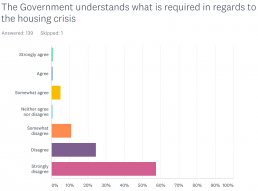
Respondents condemn the Government in their handling of housing
In our survey, we asked respondents to give the Government a mark out of 100 in regards to how they are dealing with housing. The score probably did not come as a surprise.
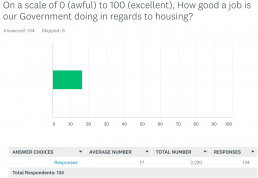
When we asked what score out of 100% they would give the Government in regards to housing, the average score was 17% and just under 90% of respondents believed that the announcement would negatively affect tenants as well as landlords with a reduction of supply and an over-inflated increase in rents.
What has happened and what will happen with rents?
The chart below highlights what has happened with rents since they were monitored back in 1993. You can see the effects of the rent freeze towards the end of the chart when rents dip. Then, post-September 2020, we see a sudden spike in regards to rents. The information is collected by Tenancy Services and this relates to the data that they obtain when new bonds are being lodged. What the data fails to do is to identify what is happening with rents of current tenants though one can suspect that a large percentage of tenants would have experienced rent increases within the last six months.
This is why we may not see the true impact of the Governments stance on removing interest deductibility against rental income until October 2021 as many landlords will not be able to put up rents for at least another six months. As soon as landlords are able to increase rents, we may see many landlords become more aggressive with regards to rent increases due to the fact that they are gradually going to be paying taxes that just over a month ago, they would never even of had to contemplate.

Ever since the rent freeze ended towards the end of September, rents have increased an average of 5.18% from the same month the previous year. Researching data provided by MBIE in regards to rents and bonds lodged since 1993, the median annual rent has increased by 4.2% per annum. The current annual inflation rate is at 1.5%. Over 64% of those surveyed believe that rents will increase by more than 5% in the next 12 months with over 20% believing that rents could increase in excess of 10%.
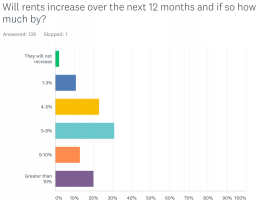
The feeling of many throughout the survey was that rents had increased due to the number of extra costs that landlords have been burdened with and many in the survey are saying that landlords are starting to sell because there is simply no incentive to own a rental property anymore. The extra costs that landlords will be liable for when the removal of the interest deductibility kicks in will see many landlords who stay the course with their investments put rents up more aggressively.
What about rent controls?
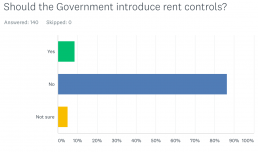
We asked in the survey whether participants believed that the Government should introduce rent controls meaning that rents could only be increased in line with inflation or if you made substantial improvements to the property. 86% believe that rent controls should not be introduced.
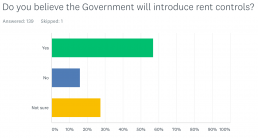
However, when we asked whether you believed that the Government would introduce rent controls, the majority of the respondents believed that they would with 57% of respondents saying that rent controls will be introduced. 16% didn’t think that they would be introduced whilst 27% were not sure whether they would be introduced or not.
Will the situation improve for tenants?
If the majority of respondents to our survey are correct, tenants are in for a very tough time. Many of our respondents believe that rents will increase substantially as well as predicting that there will be a shortage of rental properties available for tenants as many will not be in a position to purchase a property. With more properties selling or converting to AirBnB in an attempt to avoid the removal of the interest deductibility against rent, we will likely see a shortage of supply. This will lead to an increase in demand and marginalised tenants will find themselves in a precarious position as they may find it hard to secure a tenancy. Many expressed concerns with regards to the growing list of people dependant on the state for assistance with comments made around the number of people being housed in motels.
The consensus of opinion is that these changes will do nothing to improve the plight of tenants and will actually make their situation worse.
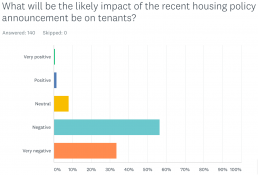
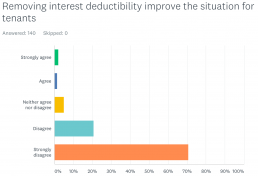
In particular, removing interest deductibility will impact tenants in a negative way. Over 70% of respondents strongly disagree and 21% disagree that this introduction will improve the situation for tenants. Only 4% of respondents believe that this policy will improve tenants situation.
What about the Bright Line Test?
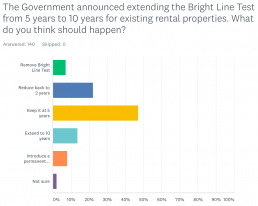
There were mixed views in regards to the Bright Line Test but the majority of people (47%) believe that the status quo should remain and keep it at five years. 14% believe that the Government is right to extend it to 10 years whilst just under 8% believe a permanent Capital Gains Tax should be introduced to residential rental properties.
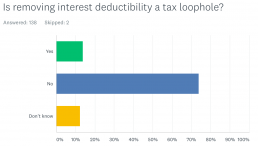
Whilst the majority of you believe that the Government is wrong in calling the removal of interest deductibility against rent a ‘tax loophole’. Nearly three-quarters of all respondents do not consider this to be a tax loophole.
How will the changes impact the Property Management industry?
Not good according to the survey and this again, is hardly a surprise. With fewer investors in the market, the pool of new business leads will shrink considerably and many landlords may turn to self-management in an attempt to control the costs. In our opinion, this is not good for all parties as many landlords lack the knowledge, time and skill to manage a rental property professionally. Recently, more and more landlords were turning to Property Managers as a result of the changes made by the Government in terms of increased legislation and compliance. The announcement in particular in regards to interest deductibility is going to negatively impact our industry as landlords will look to trim costs to make their investments stack up. Small businesses, in particular, may find it hard to grow their businesses as a result of this announcement and this could also have a negative impact on the value of rent rolls.
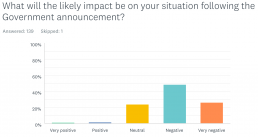
And finally, it is hardly a surprise to see that over 90% of you believe that the situation will be negative for landlords.
Comments from respondents below
Rather than pick out the odd comment, we believe it was only fair to highlight all the comments made by the individuals who completed the survey. The overwhelming majority are condemning the Governments response. Enjoy the comments below. I have altered the grammar and mistakes on some of the responses below.
Already 10% of my portfolio has gone on the market or sold since 1 January due to the number of changes and escalating cost. This is just removing homes from the rental market and increasing rent due to supply and demand.
No
A trained monkey could come up with better policies than the current government
The housing crisis has got a lot worse, and for the government to create this so call housing policy will only cause further issues. Owners will look to sell, increase rents or change how they have their rentals set up which may include Air BnB, holiday houses etc. They have just removed the options for investors to purchase more rentals to help the tenants out and provide them with accommodation. I believe their focus should be put on providing more social housing, whether it is rebuilds or purchasing of rental properties.
One comment as to why there are fewer rentals is – We are losing units to developers who are replacing them with homes for first homes buyers where are those tenants supposed to go? This is only one, there are too many people who work and are in state housing why they now are on a living wage? Time to give them notice oh you can’t do that it’s not kind
Criminal.
I feel their policies may be more applicable for City areas. In the small provincial town where I am, it is 100% taking homes out of the rental pool making it harder for tenants.
Idealistic socialism! Counterproductive and counter-intuitive to a market shortfall Tired of the “landlord bashing”
Rents will only increase and fewer properties will become available therefore making the housing shortage worse.
It is not well developed or consulted
Hold a snap election ASAP then we can get a real Govt
Like a monkey with a shotgun, pretty cute, but very dangerous.
I think the government understands the issue however the solutions they have are not matching. Therefore it comes down to execution rather than defining the problem
When campaigning they said they would make rents cheaper and improve the housing situation, by it has worsened.
Unfortunately, I believe the tenants will cope with the extra costs involved, fingers crossed these changes help create more homeownership however I don’t believe that will be the case.
More transportable housing that people can afford will be better and warmer than the older houses we have now
Hold a snap Election this Govt needs to be gone ASAP
They have no idea what they are doing how to run an economy or the country. I hope the stupid people that voted for them last time see sense and don’t cite them in next time
Labour is in it to get as many votes as possible to stay in power. The more people in social housing, emergency accommodation or on WINZ the better it is for them. They are a communist government in disguise. They don’t care what is really good for the country so long as it’s good for Labour. They don’t have a clue how to solve the housing crisis because if they did they wouldn’t be punishing landlords who provide the majority of housing. We have a wood shortage because we export our best wood – go figure! How are they going to build more houses! Next, we will be importing wood that is more expensive than our own.
It feels like their policies have been rushed through without talking to the coal face to see what we see. We now have emergency housing tenants that are very unlikely to succeed in securing a rental property. These can be potentially good tenants but who will risk putting them into their rentals
It’s great that the government want to make housing better for tenants and at most, this does need to happen but the way they have gone about it is wrong. If you introduce anything that makes landlords better their property and have to spend money, the flow-on effect will reach the tenant in the way of dearer rents. Unfortunately, they are penalising owners which means they will leave the industry. Houses are getting too expensive for landlords to buy to make money off and if you introduce rent controls, there will be no money to be made for a landlord/investor. Even first home buyers can’t afford the housing so who is actually going to buy all the stock once landlords leave the market?? Maybe the government will buy it in the form of state housing. Crazy as I don’t think the government have much clue as to the legislation they have written, it’s so confusing and makes no sense a lot of the time!
There will be more of a shortage of rental accommodation as landlords will sell their rentals, the majority of tenants still won’t want to or can afford to buy and NZ taxpayers will fund the emergency accommodation. The government have too much control over what landlords do as it is but with the new laws it’s becoming quite a socialist country.
The media only cover one side of the story, Property Managers who are trained in their fields are never approached about the housing and rental situation. Under this Government, the situation for emergency housing has increased because of their new legislation. It will not be improved any time soon under this Government.
Yes a more consultative process
Absolutely out of touch with the reality of the market and the effects that these retarded changes will have
It is an uninformed policy with significant side effects they haven’t considered. They need to stop mucking around with the legal side and focus on how we can get more houses built.
Healthy homes requirements are too high at a time when there is a high housing shortage. From 1 July 2021, there will be a further problem when properties that would normally come onto the rental market as the “accidental investor” when owners absent due to job or study transfers for a year won’t meet requirements, so they will leave them empty, not prepared to spend extra on a new bigger heat pump and extractor fans and reports as well as all the other risks perceived. Their homes may be perfectly average but not up to high enough standard. Better than people living in motels.
I feel like they are slapping in these grandis policies on a national scale (very quickly too) and not actually playing out each eventuality that can occur. It seems aren’t rooted in reality. Why hamstring landlords and why not just pump out social housing and housing in general. Give the people on the ground every ability to fill the supply hole on a private and public level. Purpose-built emergency housing, social housing and lessen barriers to building privately. Bring supply up and naturally, the market will correct, more people will be able to purchase cheap homes due to the greater supply. Build small 1 and 2 bedroom houses/units so beneficiaries can live in them instead of motels. If they don’t want to live in them, work up and get out. At the moment governments and consecutive governments have made it more and more difficult to work out of poverty. No one can save with the rents they have to pay at the moment.
They have no idea of the effect they have on the industry. It was highlighted when the PM stated in a press interview last year that she would be disappointed if Landlords increased rents because of the legislation changes. Go figure!! Property investment is a business and this government has no inclination to assist businesses. Sadly the tenants will miss out.
Typical playing with end results NOT addressing the base causes of the problem
THEY ARE TRYING TO DO THEIR BIT
The Govt is in a very difficult position with no easy solutions but this housing policy appears to set up to help middle-class millennials (children of politicians) to get on the property ladder. It has very little thought to the well-being of long term tenants who are likely to suffer from these changes.
Can we just call it a tax policy? It hasn’t done anything to address lack of housing, cost of building, homelessness, the difficulty for first home buyers to purchase, so how is it a housing policy???
Short term they may have a limited effect on curbing the number of investors buying property, but long term it will have very little effect. Those investors with large portfolios will just sell off a couple of properties to make it all work – they will be the least affected. Investors that own 1 or 2 properties may possibly hang in there and be in it for the long haul, as was their thinking when they first bought into an investment property. The problem is supply and demand, there are simply not enough houses to go around. The Govt can put all these other things in place to try to solve the problem of housing shortage, but it really just defers the problem. We need more housing.
No
They’re a bunch of wallies that consistently show us they have no real-life experience in owning rental properties or running a business.
This is a supply & demand issue and removing interest cost deducibility is not going to address the true issues.
Short sighted. Rents will go up to compensate for no tax incentive on mortgage interest. And first home buyers are renters first.
Knee jerk and populist policy
They obviously don’t understand what the impact will be in 12-18 months, this will impact landlords negatively but will be just as bad for tenants and still won’t help home buyers either, the housing crisis just got worse wait and see.
A lot of landlords are now considering selling the properties making it harder for tenants to find new homes
At least extending the bright-line test will mean owners will have to hold on to their properties for longer, but if there was a capital gains tax on investment properties only this would be fairest.
Sadly once again the Government seem to fail to understand the rules and changes they put in place like this the more it makes it very difficult for the very people they are supposedly wanting to help. There are so many factors that contribute to the housing crisis. Immigration. The Osaki case and Insurance have a big impact as does the removal of the 90-day notice. We can no longer take a chance on someone that may have had a slight hiccup along the way. Tenants need to be held accountable for their actions and making owners claim insurance is ridiculous. I have always likened renting a house to renting a car, we don’t hire a car & make alterations, not pay for it and drop it back off and say oh well too bad get your insurance to pay for it. Why should the rental property be any different? To announce such a drastic change in the interest deductibility within our tax system was sudden and the government gave no indication that something like this was about to happen this causes uncertainty across a number of industries and people become cautious of the current government’s intentions. Particularly when they were advised against it. What about blocks of flats, a first home-owner is not going to buy them why penalise people trying to provide somewhere for people to live. If they want us to build houses then they need to sort out local governing bodies councils take too long, make the process difficult etc I believe they have targeted the wrong group of people landlords are not all bad. Regulate the industry!!! Push more private landlords to property management, to qualified people.
Brightline is a Capital Gains tax, no other words should be used. It is only effective on speculators not investors, I have no concerns about it at all.
Landlords are already starting to sell their investment properties, this may be good news for first home buyers, but it will create a shortage of investment properties for tenants who either do not want to own a home (their money is in their business for example) or for tenants who prefer to tenant (it does have it’s advantages, maintenance is done at no expense to the tenant, rates and insurance are paid for etc.) As a result, rents will rise, simple supply and demand Economics 101. They would have been better seriously increasing new builds and then encourage new build housing purchasing for everyone, no matter who you are. Tenants still need to live somewhere, this will eventually end up disadvantaging some. Poor judgement and lack of foresight!
Landlords will continue to sell up as it’s just getting too hard to be a landlord.
They need to build more houses & their policy doesn’t address the underlining supply issue
They have not done their homework. They are listening to tenants rather than landlords who provide the housing that is so much in need at the moment. The RTA Amendments were meant to be a balance for both owners and tenants. NOT so, it now leans towards the rights of tenants. This Government is relying on the private sector to provide housing but not rewarding them in doing so, only if they build new homes.
No comments
The Govt needed to consult with the industry insiders before making reforms such as this
They truly have no idea how much an owner of a rental property is helping the government house people because the government does not know how to. If the government keep stabbing investment owners they will have a bigger problem as people exit the industry and again they will have no idea how to house more people
Short-sighted – there will be no winners – more owners will sell and there will be fewer houses to rent. First home buyers are now competing with Housing NZ in our area.
I agree with the initiatives that will aid tenants, like more money to build new homes, but making things harder for landlords isn’t actually going to help, because the ones that they are actually targeting – the ones with multiple properties – are going to be the one who feels the impact the lease. They can sell one property and the other 19 will balance out. It’s the ‘mom and pop’ investors, who only own one or two extra houses – and who are usually the better, caring landlords, that are going to be hardest hit, and most likely to sell – good for first home buyers, but bad for the (probably long term) tenant who has to leave and enter a competitive market, and bad for the landlord who is counting on that investment for retirement.
I’m speechless
The process adapted to install this reeks of Muldoon
The government need to take a step back and think long and hard about the changes that they make, and not just the impact that it has on the tenants (in their mind for the better), but what the impact is on the landlords as this is for the worse. They have no idea what a mess they are creating

‘Discrimination Tax’ could lead to rent controls
-
Government takes a sledgehammer to property investors which could have a detrimental effect on the Property Management industry
-
Rent increases inevitable as social housing waitlist could balloon further
I never thought I would think this, but I do miss Winston Peters. Yes, he did create this Government back in 2017 but if he was still there, do you believe that the Housing Policy announced by the Government last Tuesday would look anything like it currently does?
There is actually a lot of good in the announcement such as investments in infrastructure and giving support to Kainga Ora (formerly HNZ). I even fully support extending the Bright Line Test (BLT) to 10 years even though the supposed ‘most honest and transparent Government’ has gone back on an election promise. Extending the BLT ensures that people invest in property long term rather than looking to flip in a few years for a substantial profit. This will give greater security to tenants knowing that any rental property they move into is unlikely to sell if the BLT applies and the landlord will be taxed on the profit of the sale.
However, one change that was announced has taken everybody by surprise and will likely have major consequences on our industry as well as renters, landlords and potentially the wider economy. The announcement that interest payments on mortgages for residential investment properties can no longer be offset against rental income changes the face and potentially the viability of residential property investment. The change will apply to any new investment purchases and will gradually be phased out over the next five years.
What has become apparent to me is that many people within our industry were unaware of regard to the consequences of this policy. Up until now, I could offset interest payments on my investment mortgage against my rental income. What this means is that if I am renting out a property at $500 a week, I would have an annual rental income of $26,000. If I am paying $15,000 of interest on a mortgage, I am offsetting this against the rental income meaning I am paying tax on $11,000 rather than the $26,000. This means the tax bill, at 33% goes from $3,630 to $8,580. The benefits of owning a rental property have taken a massive hit.
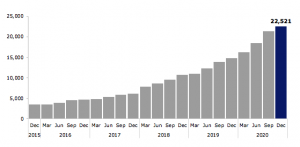
The inevitable thing that many landlords will do is increase the rents and increase them significantly as, based on the example I have just provided, this will be an additional cost to the landlord of nearly $100 a week. And this is why I believe we will see rent controls kick in. Landlords will try and aggressively push rents to levels that will be beyond sustainable for many renters and the Government will be forced to act. More money on rent means less disposable income for the economy. Also, the ballooning social housing waitlist which has increased by a whopping 548% since December 2015 will increase even further and the people that Labour promised to help the most will be hurt even more.
"In many cases, rent control appears to be the most efficient technique presently known to destroy a city - except for bombing." - Assar Lindbeck; Sweedish professor of economics 26th January 1930 - 28th August 2020
What does this mean to the Property Management industry?
The added costs will not only have an impact on rents, but it will also likely have a significant impact on the Property Management industry. It will mean that some landlords who have used a Property Manager or were thinking of using a Property Manager may decide to try and self-manage as they look to try and cut costs. If and when a landlord tries to do this, the cost of a Property Manager could be an expense that they will try to recover by managing the property themselves. This could be good news for new platforms and hybrid Property Management models such as MyRent and Kitt which was highlighted at the recent Regenerate 2021 conference in Queenstown as these may become more attractive models than the traditional Property Management model.
It also means that smaller Property Management companies may struggle to survive as new leads will dry up. Churn rates have traditionally sat anywhere between 15 and 25% meaning if I have a rent roll of 500, I will lose approximately 100 a year through sales, owners moving back in or for other reasons. These losses will straight away become more difficult to replace as there will be fewer people buying investment properties leading to a reduction in the pool of potential clients.
For small boutique companies, this could be terminal unless they find ways to adapted and innovate.
New builds and Build to Rent is the way to adapt.
The changes mean that traditional models of Property Management will have to evolve and the bigger players who are aligned with developers and have a strong fiscal balance sheet could probably do worse than look at options around partnering with developers for new building projects as well as focusing on the concept of Build to Rent. Concepts such as this look likely to be exempt from the BLT as well as the ‘Discrimination Tax’. This will become more appealing to people still looking at investing in property. We highlighted the concept of Build to Rent back in 2019 and this concept appears to be gaining legs.

Build to Rent is a concept where investors buy shares in a Build to Rent complex and get a return on these shares through the rental returns. The properties are purpose-built rental accommodation meaning that tenants have security as well as flexibility knowing that they can give notice when they decide to move on. The developments are better managed as Property Managers do not have to shop around for quotes to appease amateur landlords who scrimp on maintenance and rents will be fixed increasing in line with inflation. Naturally, tenancies such as this will be far more appealing to renters than renting from a private landlord.
Is the Government being fair and will the changes make an impact?
Let’s look at the first part of the question. The language that has been used by the Government and in particular Finance Minister Grant Robertson has been rather discriminatory towards property investors. Firstly, he does not seem to acknowledge that many landlords are people, like myself, who bought an investment property in a way of saving for retirement. If we had capital gains, it was simply a bonus. However, according to Mr Robertson, I, along with every other landlord are not investors but speculators. Personally, I find this quite repulsive as he attempts to pass the blame for skyrocketing house prices on innocent individuals who are simply trying to save for retirement. He is implying that I am only investing in property due to the fact that I want to see significant capital gain and I will flip the property once I have realised those gains. There is a big difference between someone who speculates in property compared to a long-term investor which is what I consider myself to be.
Next, Mr Robertson says that we have been exploiting a tax loophole. Again, I find this particularly offensive and inaccurate in its assessment. Is Mr Robertson implying that I as well as the thousands of investors around the country are deliberately using residential property investment as a tax avoidance scheme? Absolute rubbish.
As it has well been documented in the media of late, this is not a loophole. A loophole is an ambiguity or inadequacy in law or a rule that allows people to exploit or avoid their responsibilities. I certainly do not feel that I am exploiting any law by owning a rental property and the practice of offsetting interest against income is a standard worldwide business practice. If Real iQ takes out a loan to buy a car or a commercial office, the interest can be offset against the income. What is the difference in owning a rental property?
It is a tax based on discrimination. It discriminates against the thousands of investors who are simply trying to put money aside to fund their retirement. The language that Robertson uses implies that investors are really speculators, driving up rents and exploiting tax loopholes.
Is it fair? Absolutely not. New Zealanders have been encouraged to save for their retirements and the fact that there was no warning, and they went to such an extreme length suggests that they are simply looking for a scapegoat rather than looking in the mirror at their own inadequacies and clinging on to ideology rather than reality.
Labour commit political Hare Kari but why are National silent?
When I first read the announcement on Tuesday, my first thought was shock around the discrimination tax and my next thought was ‘Labour have just given National the next election’. This is political suicide which will negatively affect so many landlords as well as tenants with rising rents. Surely not even National can screw this up.
However, the silence from National is deafening. Instead, they have been focused on trying to get the Speaker of the House, Trevor Mallard, sacked for wrongly accusing a Parliament staffer of rape. Mallard’s behaviour has been appalling and he should be gone, but they seem to have missed the boat in attacking the Government on the discrimination tax.
What National needs to do is settle on who is going to lead the party and then start challenging Labour on policy rather than the behaviour of individuals within the party. Should it be Collins at the helm? I’m not sure, my own personal choice would be Nicola Willis, National’s Housing spokesperson. She is articulate, highly intelligent and is still only 40 so she will connect with younger voters. She is the right person to challenge Ardern who, for probably the first time in her political career, has come under so much scrutiny.
As I have argued for a long time now, Labour’s main election promise back in 2017 was to fix the housing crisis and make life better for renters. Their announcement at 9.00 am on Tuesday the 23rd of March is certainly going to make an impact. Only time will tell if it works. I have my doubts.

'Nanny State' is a sign of the times
Mandatory pricing on For Rent signs is utterly ridiculous protects nobody and highlights a ‘paternalistic nanny state’ approach towards being a landlord and the Property Management industry argues David Faulkner.
Some things that appear to be rather minor can be really, really irritating. Let’s take having to put the rental price on a For Rent sign for example. I had first heard grumblings about this after a number of people had contacted me towards the end of last year asking me my opinion on the matter. This is after they had been advised that this is what they had to do after they had attended a Residential Tenancies Amendment Act roadshow. My answer at the time was ‘don’t be ridiculous!’
But no, this advice is apparently correct. Tenants have become so endangered that now you cannot put a ‘For Rent’ sign on a property without displaying what the price is. Can someone please explain to me how this is apparently protecting tenants’ rights? I do not know who comes up with these ideas in the depths of the public sector amongst the corridors of Wellington but someone has come up with an absolute pearler here!
On the whole, I am very supportive of the changes to the Residential Tenancies Act. Attitudes to how we treat tenants and renting, in general, have to evolve. I was one of the first in the Property Management industry to publicly say the changes were necessary and tenants do deserve a valid reason as to why they have been given notice. However, we are seeing a small but disturbing trend towards a paternalistic approach in regards to the implementation of legislation and governance of renting and property management.
What do you think? Should prices on For Rent signs be mandatory?
How having to state the price on a For Rent sign is protecting tenants is beyond me. No one seems to be able to give me a valid reason as to why such an approach is being taken. You may rightly ask why is this such a big deal and what is the problem with putting the price on a For Rent sign anyway?
In terms of practicality, it is more an inconvenience than anything else. To me, it is the principal of stance which irks me so much. In my opinion, it actually contradicts what is stated in the amendments. There are also issues around such a stance. The public sector sometimes fails to take into consideration the added time and costs that companies have to bear by following such a stance.
- The ‘For Rent’ signs cannot be recycled and used again meaning more cost.
- If the price changes, someone has to travel out to the sign and adjust the price on it. In some cases, this could be a considerable amount of time as well as another vehicle unnecessarily being placed on a road. In some cases, particularly in rural New Zealand, this could mean a two hour round trip.
- There will be added costs in such an exercise. More signs being used, more petrol and travel time as well as a lack of productivity.
If this is to be enforced and god forbid it will be, what will likely happen is that companies will stop putting ‘For Rent’ signs on properties. And yet, throughout all of this, nobody can explain to me how it actually protects tenants.
It wouldn’t be such a contentious issue if the legislation said this is what you had to do. On the contrary, the new legislation says something completely different.
Section 22F: Landlord must state amount of rent when advertising residential premises
(1) A landlord must not advertise or otherwise offer a tenancy of residential premises unless the amount of rent is stated in the advertisement or offer.
Firstly the landlord does state the amount as this is clearly displayed on multiple websites. It also does not say all advertising. It says advertisement or offer, not advertisement and offer. There is a big difference between an advertisement and an offer. We are clearly not offering the property to everyone who views it, the prospective tenant first has to apply for the property before an offer is made and background checks have to be carried out. There is also another issue here. Under section 123A of the RTA, a landlord now has to keep copies of the advertisement of the property for rent for up to 12 months after the end of the tenancy. If we are going off the advice we have been given, we are now going to have to keep a copy of the ‘For Rent’ sign for up to 12 months after the end of the tenancy as well. Let’s say there is a large Auckland company that has 4,000 managements with the average length of a tenancy being two and a half years. This means this company will have to store an average of 1,600 signs per year. After three years they will have to have stored 4,800 For Rent signs securely stored labelling what the property was and what the price is.
I can picture the scene now! Some large Property Management companies will have to lease commercial warehousing so they can store the thousands of For Rent signs that will have to be kept so they remain compliant. This is how ridiculous things have become. Whatever happened to common sense?
How did we get here?
This issue made news when an Auckland Property Management company proudly promoted the fact that they would not put prices on properties For Rent and would tender rental properties to the highest bidder. The capatlist in you may think ‘fair enough’ this is the basic rules of economics at play with supply failing to keep up with demand. However, most people thought it was somewhat unethical and the idea was never really going to take off.
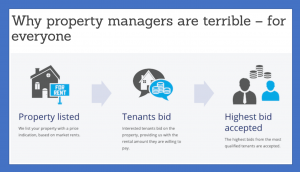
The reality was very different from what the media latched onto. This was only one company taking such an approach. If anything, it was more a distraction than outrage and the reality of this becoming mainstream was highly unlikely. However, a Labour party who at the time had recently formed the Government made a political gain from the headline with Phil Twyford calling the practice of rent bidding ‘unacceptable’. In fairness to Phil, nobody really objected to the ban on rent bidding as it wasn’t seen as a problem and yes, it probably is an unethical practice. This was very similar to increasing the period for rent increases from 180 days to 1 year. The vast majority of people within the industry were actually very supportive of this change.
When the amendments were finally announced, all the focus was on the security of tenure and the end of no cause terminations rather than something as paltry as having to state the price of the rent on your advert.
But now, it has become an issue and everybody I have spoken to within the industry says the same thing. It is ridiculous.
The stance is such that anybody new to the country looking in must think that the internet does not exist in New Zealand and every Saturday morning there is a frenzy of poor tenants being forced to make bids on rental properties that they cannot afford with the greedy money hungry agent driving up the price, not caring about the impact of their actions. Whilst all of this is going on, hordes of ‘out of luck’ tenants are left frustrated, angry and feeling exploited.
This is a classic case of a divide between the private and public sector. A team of bureaucrats write a policy but they have no understanding or idea in regards to the complexities and challenges that businesses face on a day to day basis. Yet, despite this, they fail to actively engage with the industry before making such a policy.
This is similar to the overly excessive ‘Tenancy Services Healthy Homes statement’ that is 13 pages long. This turns the Tenancy Services Tenancy Agreement into a painful 22-page document.
I for one like the adage of ‘keeping things simple’. There will be many tenants across the country who would struggle to read and fully understand such a complex document. Why do we have to make things harder than they actually are?
This is similar to a Heating Calculator that is failing ‘new builds’ which pass the Building Act, are fully consented and are fine for an owner-occupier to live in. But god forbid a tenant risk their health by living in such a dangerous dwelling.
Change is needed to protect tenants and I am fully supportive of initiatives that give greater security to tenants as well as ensuring that they live in warm, safe and compliant homes. However, once a change becomes so oppressive, they fail to serve the purpose that it was designed for and they cause more damage than good. Instead of focusing on such petty matters such as prices on For Rent signs, they should be focusing on matters such as finally setting containment standards for rental properties. Last month we highlighted the fact that standards were due to be set by the 31st of January 2021, a deadline set by the executive. They had a timeframe of eighteen months to set standards and it failed to achieve the deadline. These are standards that need setting and we are still waiting.
David gives his opinion on the Government failing to set standards for contaminants
In the latter years of her leadership, former Prime Minister Helen Clark’s government was accused of becoming a nanny state. This was primarily because of the backlash from the anti-smacking bill. But it went further than that with her Government telling people what size showerheads and which lightbulbs they could use. Ultimately, they did not recover and National came to power soon after. I am not suggesting that this will happen with this Government, but the level of bureaucracy has increased exponentially since Labour came to power. Ultimately, the cost of this is paid for by the tenant as increased costs with increased compliance are passed on by the landlord.
So I end this article with a plea for common sense to prevail. We all make mistakes from time to time. The Privacy Commission openly admitted that it got its first attempt to set guidelines for selecting a tenant wrong. They listened to stakeholders and made the appropriate changes. Can the people in charge of administering the act please do the same thing?
I for one would have no intention of following their guidelines and if Tenancy Compliance and Investigation Team have nothing better to do than waste taxpayers money by taking someone to Tribunal for such a trivial matter, then all it does is highlight the failure of the system.
The motivation should be about protecting tenants rights, not enforcing a punitive policy that serves nobody. Wake up and let common sense prevail.
David Faulkner

Testing times ahead
There are small but hugely significant changes to the Residential Tenancies Act that have largely gone unnoticed and it has nothing to do with the pending reforms
Are you ready for the changes to the Residential Tenancies Act that are due to come into law as of the 1st of February 2021? “Hang on! Isn’t the Residential Tenancies Amendment Act 2020 coming into force on the 11th of February?” I hear you ask.
Yes, it is, but what about the Residential Tenancies Amendment Act 2019? You remember, the bill that made changes because of the infamous Osaki case that meant tenants were no longer liable for accidental damage?
This is also the amendment that was going to set standards on what levels of contamination are before a property becomes uninhabitable including our old nemesis, Methamphetamine!
On the 30th of July 2019, the Residential Tenancies Amendment Act 2019 (RTAA 2019) became law. This bill covered a number of things such as limits around tenant’s liability for accidental damage, giving jurisdiction to the Tenancy Tribunal to make rulings on unlawful residential dwellings as well as introducing amendments relating to methamphetamine and other contaminants. This includes setting the standards for what acceptable levels of contamination is before a property is deemed to be uninhabitable. The 2019 bill states that those amendments have to come into effect within 18 months of the bill getting royal assent. Those 18 months are up on the 31st of January 2021, meaning a legally bound standard will become law. But before we look at what the amendments are, let me take you on a brief history lesson around the boom and bust of the meth testing industry.
The birth of the meth testing industry
Back in 2010, a report was commissioned and published by the Ministry of Health due to the increase of meth laboratories around New Zealand. The detection of ‘clan labs’ by the New Zealand Police had increased from 9 in 2000 to 135 in 2009.[1] This document outlined what steps should be taken for the remediation of ‘clan labs’, stating that “The Ministry of Health currently recommends that surface wipes for methamphetamine not exceed a concentration of 0.5 μg/100 cm2 as the acceptable post-remediation re-occupancy level for a dwelling that has been used as a clan meth lab.”
All well and good, but somehow, this standard was adapted, largely through the fault of the Tenancy Tribunal, as the acceptable level for contaminated properties where meth had been consumed as well as contamination from manufacturing. This led to the birth and rapid expansion of the meth testing industry.
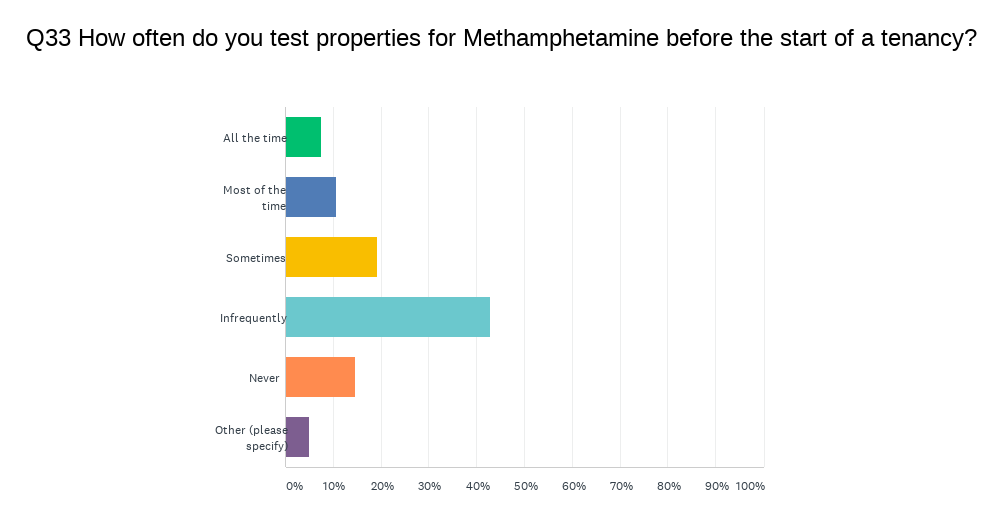
Scepticism grows
As more and more cases started appearing in the Tribunal, particularly from 2015 onwards, there were concerns that an industry was growing without regulation or any specific recognised training meaning that it was open to abuse from cowboy operators and people with a conflict of interest. More and more cases made their way to the Tribunal and as the Tribunal had set the standard of 0.5μg/100cm2 (as stated in the 2010 guidelines) for all properties, the floodgate for Tribunal claims and evictions opened, and a tsunami of claims was made. Tenants were evicted from their homes as properties were deemed to be uninhabitable as section 59A of the RTA was enforced meaning that tenants could be given only 7 days’ notice to move. Five figure claims to the Tribunal by both landlords and tenants were not uncommon. The Tribunal decided that for claims to be valid from landlords, there had to be a pre-tenancy test to prove the property was clean and an end of tenancy test so if levels of meth had increased above the 0.5μg/100cm2 standard, the tenant would be liable for the clean-up. This led to pre-tenancy testing becoming almost mandatory within the property management industry.
People, including myself, started to publicly question the morality of the people doing the testing and clean-up work and asked whether this was just a giant scam. Millions of dollars were being paid out in insurance claims and being awarded through the Tribunal. Millions of dollars were being paid to testers as well as remediation and cleaning companies. People were losing their homes and investors were losing thousands of dollars.
Setting the standards
At this point, the Government decided to act and on the 2nd of June 2016, the Ministry of Business, Innovation & Employment appointed a committee to help develop new acceptable standards for meth testing. The only problem with this committee was the fact that 50% of 18 member committee were representatives of the meth testing and remediation industries[2]. It was simply in their interest to set the standards as low as possible. They adopted a new standard of 1.5μg/100cm2 maximum levels of contamination. The publication NZS 8510:2017[3] was introduced and this would be the standard that the Tribunal would now use as it was the most up to date document.
The Tribunal cases just continued to grow, and it was now being reported that Housing New Zealand was spending millions of dollars of taxpayer money on cleaning and remediating thousands of houses.
Enter Mr Twyford and Sir Peter Gluckman
Everything changed when the Labour-led coalition took power from National in October 2017. In what was probably the best decision of his political career, the much-maligned and then newly appointed Minister of Housing Phil Twyford appointed Sir Peter Gluckman, the then Chief Science Advisor to the New Zealand Prime Minister, to investigate the risk of methamphetamine contamination. On the 29th of May 2018, the report was published, and the meth testing industry was busted.

There is no doubt that this report was a bombshell when it was released. It recommended that the standard that should be adopted was 15μg/100cm2, and even then, he noted that this was conservative. He was also critical of the use of composite testing, using multiple wipes rather than the more expensive discreet individual testing, coming to the conclusion that “single composite sample, as permitted in NZS 8510:2017, has limited value in accurately reflecting levels of risk, and depending on how the data are integrated can lead to quite misleading interpretation and false impressions of high exposure, triggering another round of expensive testing”.[4] He strongly recommended that initial testing should not involve composite testing as it could lead to a false positive.
HNZ immediately stopped testing their properties for methamphetamine and this forced the Tenancy Tribunal to adopt the Gluckman report as the new standard. The public outcry was substantial, and the fallout was immense, particularly for HNZ who unfairly copped a lot of criticism for its policy around meth testing. In retrospect, all they were doing was following the standards set by the Tribunal.
One industry that had suffered through the meth debacle was the insurance industry as they found themselves paying out millions in insurance claims for so-called meth contaminated properties. However, many of these companies decided to ignore the Gluckman report and stick with the standards set in NZS 8150:2017 meaning that pre-testing was compulsory, and claims could be made for anything over 1.5ug/100cm2. And this is where we are today. Insurance and the Tribunal working to two different standards.
What is the standard and what happens next?
With the inception of the RTAA 2019, we have two new sections to the RTA which are still to come into effect but once the 18-month deadline takes effect on the 31st of January 2021, they must be introduced to the RTA. What are the sections?
Section 59B of the RTA: Termination where regulations prescribe testing methods and maximum inhabitable level of contaminant. In short, this section outlines when a property becomes inhabitable due to levels of contamination and what notice can be given.[5]
Section 45A of the RTA: Protection from liability for landlords who complies with contaminant regulations. In short, this section states that if landlords did not know the property is contaminated prior to renting it out, they are not liable to the tenant.
These new sections also apply to boarding house tenancies.
So, what happens next?
Put it simply, I have no idea. There have been no murmurings from Tenancy Services or the Housing Minister that this is being worked on and standards for contamination will be formally set. Maybe it has just been forgotten about which wouldn’t surprise me considering what we have had to go through. Maybe they are quietly working on this and will announce this on the 1st of February 2021.
One thing is for sure, the standards need to be formally set so we can finally put an end to this sorry state of affairs. I ask the Minister to formally adopt the Gluckman report into legislation and this will force insurance companies to follow suit and put an end to the ongoing debacle that has been a sorry episode of the meth testing scam.
David Faulkner
[1] Guidelines for the Remediation of Clandestine Methamphetamine Laboratory Sites, Ministry of Health, August 2010.
[2] https://www.standards.govt.nz/touchstone/building/2016/jun/committee-appointed-to-develop-meth-testing-standard/?utm_campaign=ts&utm_medium=feature&utm_source=homepage
[3] NZS 8510: 2017 Testing and decontamination of methamphetamine-contaminated properties, June 2017
[4] Office of the Prime Minister’s Chief Science Advisor: Methamphetamine Contamination in residential properties: Exposure, risk levels, and interpretation of standards: Professor Sir Peter Gluckman, ONZ KNZM FRSNZ FMedSci FRS, Chief Science Advisor. 29 May 2018.
[5] Residential Tenancies Amendment Act 2019